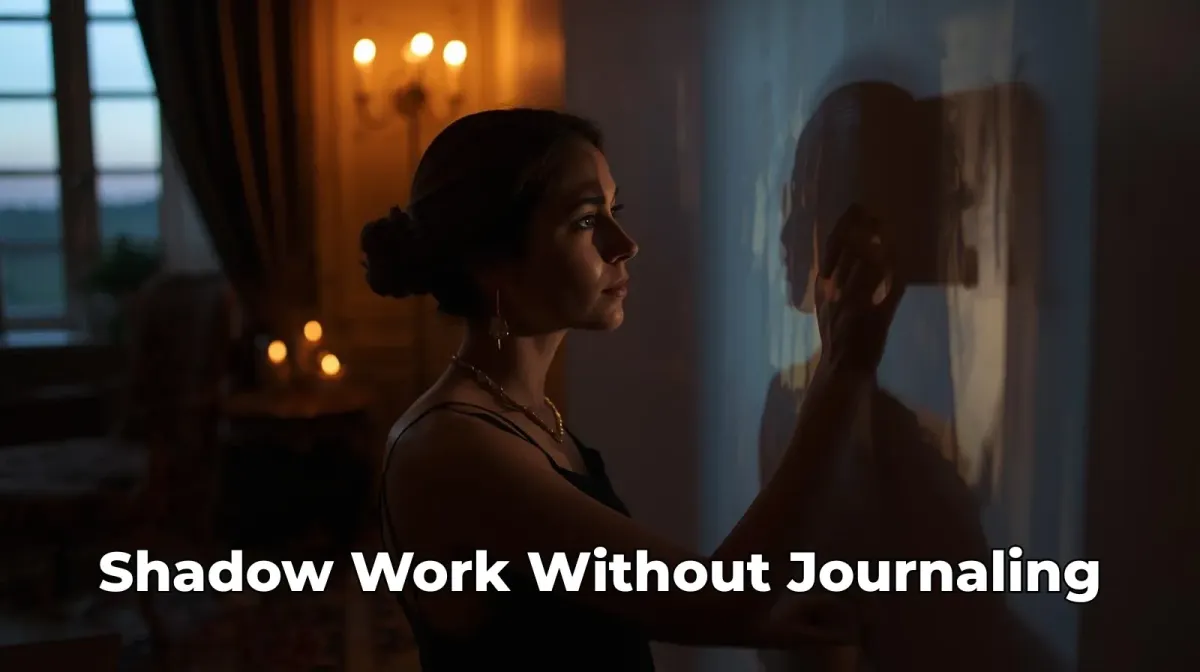
Shadow Work Without Journaling: Somatic and Visual Methods
Shadow work is often presented as a writing-based practice. Journals, prompts, and structured reflection are commonly positioned as the primary doorway into unconscious material.
But shadow work without journaling is not only possible — for some people, it is more effective.
Writing can be powerful. It slows thought and creates clarity. If you are new to the wider framework of this work, begin with What Is Shadow Work? A Complete Guide for a grounded overview.
If you prefer a structured writing approach, the Shadow Work and Journaling article explores that method in depth.
However, shadow material does not live only in language. Much of it lives in sensation, posture, imagery, movement, and felt experience. When writing pulls you further into analysis or self-monitoring, body-based and visual methods may offer a more accessible path.
This guide explores shadow work without journaling, using somatic and visual techniques that prioritise regulation, integration, and steady awareness.
Why Journaling Does Not Suit Everyone
Journaling can be helpful. It offers structure and can slow down thinking. For many people, it creates clarity.
But it is not a neutral tool.
For some nervous systems, writing activates:
Over-analysis instead of emotional processing
Inner critic patterns
Rumination or repetitive thinking
A sense of pressure to “get insight”
In these cases, journaling shifts attention into cognition rather than connection.
Shadow work is not about producing insight. It is about restoring relationship with disowned parts. If writing consistently pulls you further into mental effort and away from felt experience, it may not be the most supportive doorway.
This does not mean journaling is wrong. It simply means shadow work must adapt to the person — not the other way around.
Shadow Work Is Not Only Cognitive
One common misunderstanding is that shadow work is primarily a thinking process.
In reality, many shadow patterns formed before language was fully developed. They were shaped through early relational experiences, repeated emotional responses, and bodily survival strategies.
This is why people can understand their patterns intellectually and still feel stuck.
Insight alone does not dissolve protective patterns. The body often continues to respond as it learned to respond.
Somatic and visual approaches meet the shadow where it lives — in sensation, posture, imagery, and felt experience — rather than trying to analyse it away.
If you are at an early stage of this work, Shadow Work for Beginners: A Gentle Guide for Empaths offers a steady foundation before exploring alternative methods.
Somatic Shadow Work: Body-Based Awareness
Somatic shadow work shifts attention from analysis to sensation.
Instead of asking, “Why do I feel this?”, the focus becomes, “What is happening in my body right now?”
Many shadow patterns show themselves through physical signals before they appear as thoughts. These can include:
Muscle tension
Changes in breath
Postural collapse or rigidity
Heat, heaviness, tightness, or numbness
These sensations are not problems to fix. They are information.
A simple body-based practice begins by noticing mild emotional activation. Bring attention to the body and describe sensation without story. Tight. Heavy. Warm. Contracted. Stay present for a short period without trying to change anything.
This builds tolerance and witnessing capacity. That capacity supports integration more reliably than analysis alone.
Keep the work steady. Mild activation is enough. If intensity rises, pause and orient back to the present.
If you would like a broader foundation in working gently with difficult material, Shadow Work for Healing Trauma: A Gentle Guide for Sensitive Souls offers additional context without moving into writing-based methods.
Movement as Shadow Expression
Movement allows shadow material to express without narrative.
This can include:
Gentle shaking
Slow stretching
Intuitive movement
Postural exploration
Micro-movements that release held energy
Movement is especially useful for:
Anger held in the body
Suppressed emotion
Over-control patterns
Freeze responses
There is no choreography. The aim is expression, not performance.
Movement-based shadow work is particularly supportive for those who struggle with emotional suppression.
If creative expression feels like a natural doorway for you, Creative Shadow Work: Heal Through Sound, Movement & Art brings these approaches together through simple sound, movement and art practices that allow emotion to be explored without relying only on words.
Visual Shadow Work: Working With Image
The unconscious communicates naturally through image and symbol.
Visual shadow work allows material to surface without requiring verbal explanation. It reduces reliance on analysis and creates space for indirect expression.
This can include:
Simple sketching or drawing
Working with colour
Selecting images that resonate
Creating basic collage
Brief guided imagery
The aim is not artistic quality. It is contact.
When working visually, allow the image to emerge without forcing meaning. Notice what feels present. Stay curious rather than interpretive.
Sometimes the act of creating is enough to shift internal tension. Integration does not always require explanation.
Visual methods can be especially useful when writing feels repetitive or overly analytical. They offer a different doorway without replacing other approaches.
Using Objects for External Perspective
Some shadow material becomes clearer when it is externalised.
Using simple objects can help represent parts, emotions, or internal dynamics without relying on explanation. The object itself becomes a placeholder for experience.
This might involve:
Placing stones or small items to represent different emotional states
Positioning objects to reflect tension or distance
Moving items closer or further apart to explore internal shifts
Seeing parts in physical space can reveal relational patterns that feel less visible internally.
The purpose is not symbolic interpretation. It is perspective.
When something is placed outside the body, it often becomes easier to relate to with steadiness rather than reactivity.
Sensory-Based Shadow Work
Shadow material often responds to direct sensory input.
Engaging the senses can regulate the system while allowing emotion to surface in manageable amounts. This creates steadiness without relying on verbal processing.
Examples include:
Listening to steady, neutral music
Using rhythm or light tapping
Holding textured objects
Noticing temperature changes in the hands
Using grounding scents
The aim is not catharsis. It is contact with stability.
Sensory methods can soften defensive patterns gently. They allow emotional material to move without forcing insight or narrative.
Keep sessions brief. A few minutes is enough to notice a shift. End by orienting to the room and the present moment.
When Journaling May Not Help
Journaling is a useful tool for many people. It creates structure and can support reflection.
However, in some situations it may reinforce patterns rather than soften them.
Writing may not help if it:
Strengthens self-criticism
Encourages repeated analysis without emotional contact
Leads to rumination or looping thought
Becomes a way to avoid felt experience
When this happens, the issue is not the person. It is the mismatch between method and system.
Shadow work is most effective when it supports connection rather than performance. If writing consistently feels effortful or activating, that is information worth respecting.
Alternatives such as body-based and visual methods can offer access without increasing mental pressure.
Pacing and Integration
Shadow work does not require intensity to be effective.
Work with mild activation rather than overwhelm. Short periods of focused attention are often more useful than long sessions.
Simple pacing principles include:
Pause when intensity rises
Return attention to the room and the present moment
End with grounding rather than further exploration
Integration happens through repetition and steadiness, not force.
If you would like a fuller overview of pacing and red flags, Shadow Work Safety: Myths, Risks and Red Flags offers clear guidance without moving into writing-based methods.
Benefits of Shadow Work Without Journaling
Working without writing can create a different kind of access.
Body-based and visual methods often:
Reduce overthinking
Increase awareness of physical cues
Strengthen emotional tolerance
Support regulation alongside insight
Create gentler entry points into difficult material
These approaches can help you notice patterns as they arise in real time, rather than only reflecting on them afterwards.
They also support integration through experience rather than explanation. This can lead to increased steadiness, clearer boundaries, and more measured emotional responses over time.
Shadow work without journaling is not a shortcut. It is simply a different doorway. When the method fits, the work becomes more sustainable.
Final Thoughts
Shadow work without journaling is not a lesser version of the practice. It is a different method.
Some shadow material responds best to language. Other material responds to sensation, movement, image, and space. The work becomes more effective when the method fits the person rather than the other way around.
If writing has felt effortful, repetitive, or activating, that is not a failure. It may simply be a sign that your system engages more readily through embodied or visual contact.
Shadow work is not about producing insight on paper. It is about building relationship with the parts of you that were once hidden or rejected.
When the doorway feels steady, the integration becomes sustainable.
Next steps
If writing has not felt like the right doorway, you do not have to force it.
Shadow work can be explored through different approaches, and the important thing is finding a way of working that allows you to remain present and engaged without turning the process into another source of pressure.
If you would like a structured foundation for exploring shadow work, the Shadow Work Online Course is the clearest place to continue. It introduces shadow work step by step and helps you understand the wider patterns you may be encountering as you explore the parts of yourself that have previously been hidden or rejected.
If you have already been exploring shadow work independently and feel that you would benefit from personal guidance with the patterns you are uncovering, you can also learn more about One-to-One Coaching.
Choose an approach that allows you to stay curious without forcing yourself deeper than feels manageable.

Shadow Work Without Journaling: Frequently Asked Questions
Can shadow work be effective without journaling?
Yes. Many shadow patterns live beneath language and respond well to body-based or visual approaches. Writing is one method, not a requirement. When the method fits, integration becomes more natural.
How is shadow work without journaling different from journaling-based shadow work?
Journaling relies on reflection through language. Shadow work without journaling uses sensation, movement, imagery, or physical space to explore internal material. Both approaches can be effective, but they engage different processing pathways.
Is this approach suitable for beginners?
Yes. Body-based and visual methods can offer a gentle entry point, especially if writing feels effortful or overly analytical. If you are new to the wider framework, begin with What Is Shadow Work? A Complete Guide to understand the foundation first.
Can somatic or visual methods bring up too much emotion?
They can if intensity is not paced carefully. Work with mild activation and keep sessions short. If intensity rises, pause and return to grounding. Steady progress is more effective than pushing for insight.
Should I combine journaling with these methods?
Only if writing feels supportive. Somatic and visual methods stand fully on their own. The aim is integration, not using every tool available.
Shadow Work Videos
Prefer to learn by watching? This short, gentle series gives you the essentials. Clear. Trauma-aware. HSP-friendly. Start here, then come back to the article when you’re ready.
What Is Shadow Work — a simple overview and why it matters.
Shadow Work for Beginners — safe first steps and common mistakes to avoid.
Shadow Work Journaling Prompts - What and how to prompt for shadow work.
Shadow Work for Empaths and HSP's - A sensitive guide to shadow work.
5 Signs You Need Shadow Work - Simple signs to see if you need shadow work.
Shadow Work For Healing Trauma - A gentle guide that is trauma aware.
Take your time. Pause when you need. Save the playlist and revisit whenever you want a calm refresh. More videos will be added soon.

Further reading
If you would like to explore shadow work more broadly, these articles deepen the framework without relying on writing-based methods:
What Is Shadow Work? A Complete Guide
A grounded overview of shadow work, integration, and common misconceptions.Shadow Work for Beginners: A Gentle Guide for Empaths
A steady starting point if you are new to the practice.Shadow Work for Healing Trauma: A Gentle Guide for Sensitive Souls
How to approach shadow material with regulation and pacing.Shadow Work and Self-Love
Building relational safety with the parts you once rejected.Shadow Work Safety: Myths, Risks and Red Flags
Clear guidance on pacing, readiness, and when to pause.
I look forward to connecting with you in my next post.
Until then, be well and keep shining.
Peter. :)